
Updated 2026
Every rent-vs-buy guide answers this with a number of years. Five. Seven. Ten.
We ran the model on Seattle's actual August 2026 numbers, and the honest answer isn't a year at all. The break-even depends almost entirely on what a renter does with the money they don't spend on a mortgage. Change that one behaviour and the answer swings from year one to never.
Here is the arithmetic, the assumptions behind it, and the point where it flips.
KEY TAKEAWAYS
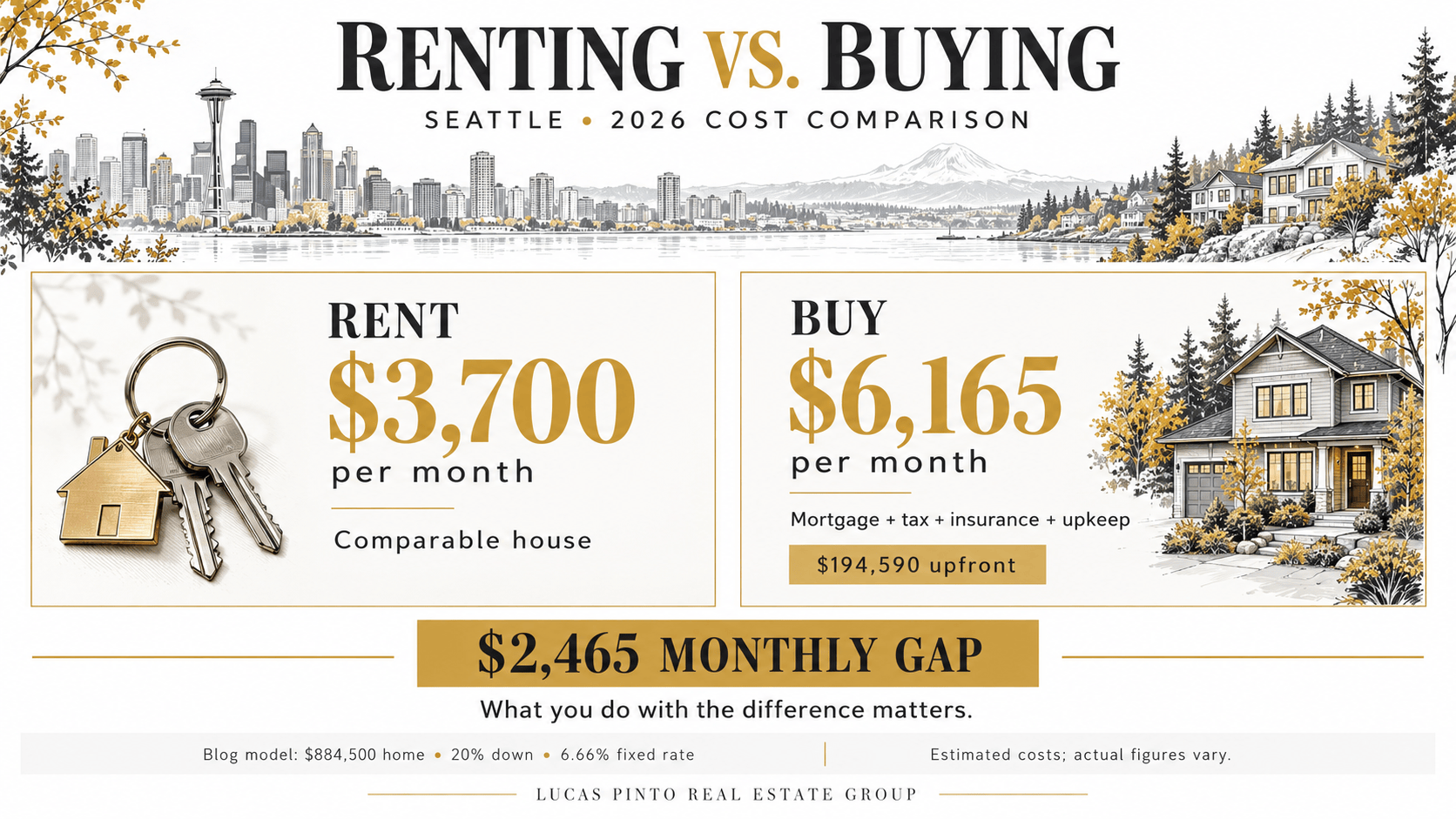
- Owning Seattle's median home runs about $6,165/month all-in, against $3,700 to rent a comparable house a $2,465 monthly gap.
- Upfront cost to buy is about $194,590 (20% down plus closing).
- If a renter invests that gap at 7%, buying does not break even within 15 years.
- If a renter spends the gap instead, buying is ahead from year one.
What are the actual numbers in Seattle right now?
Every figure below is current and sourced. This is where most rent-vs-buy articles quietly use last year's data.
| INPUT | FIGURE | SOURCE |
|---|---|---|
| Seattle median sale price | $884,500 | NWMLS, July 2026 |
| 30-year fixed mortgage rate | 6.66% | Freddie Mac PMMS, 27 Aug 2026 |
| Seattle property tax levy | $9.90845 per $1,000 (0.99%) | King County Assessor, 2026 |
| Median apartment rent | $2,083 (−2.7% YoY) | Apartment List, July 2026 |
| Median 3-bed house rent | $3,700 | Rentometer, 2026 |
| Down payment | 20% ($176,900) | assumption |
| Closing costs to buy | 2% ($17,690) | assumption |
| Insurance | $1,800/year | assumption |
| Maintenance | 1% of value/year | assumption |
One methodological point that changes the whole answer. Comparisons routinely put the $2,083 median rent against a median house purchase. That's apples to oranges $2,083 is mostly apartments. Renting a house comparable to an $884,500 purchase costs about $3,700. We use $3,700 throughout. Using the apartment figure would overstate the cost of buying by roughly $1,600 a month.
What does owning actually cost per month?
| COMPONENT | MONTHLY |
|---|---|
| Principal and interest ($707,600 at 6.66%) | $4,547 |
| Property tax | $730 |
| Insurance | $150 |
| Maintenance reserve | $737 |
| Total | $6,165 |
Against $3,700 to rent the equivalent house, that's a gap of $2,465 per month, plus $194,590 required upfront.
That gap is the entire argument. Everything below is about what happens to it.
Why most rent-vs-buy math is wrong
The standard version compares total rent paid against total mortgage payments, concludes that rent is money you never see again, and stops there.
That comparison has two holes.
It ignores what the down payment could have done. $194,590 invested rather than spent is not nothing. Over ten years at 7% it roughly doubles. Any model that treats the down payment as though it vanished is stacking the deck.
It ignores the cost of getting out. Selling isn't free. At $884,500 you're looking at roughly 5% commission plus $14,804 in Washington excise tax real money that comes off the top before you see a cent of appreciation.
Our model handles both. Both parties start with the same $194,590. The owner spends it; the renter invests it and also invests the monthly difference. At each year we compare net worth: the owner's sale proceeds after commission and excise tax and mortgage payoff, against the renter's portfolio.
So when does buying actually pay off?
Here's the answer, and it isn't a year. Assuming 3% annual home appreciation and 3% rent growth:
| WHAT THE RENTER DOES WITH THE $2,465/MONTH | BREAK-EVEN YEAR |
|---|---|
| Invests it at 7% | Never within 15 years |
| Invests it at 4% | Never within 15 years |
| Saves it in cash, no growth | Year 8 |
| Spends it | Year 1 |
Read that table twice. The house doesn't change. The rate doesn't change. The only variable is renter discipline, and it moves the answer from "immediately" to "not in fifteen years."
Net worth at three checkpoints, under the 7% investing assumption:
| YEAR | OWNER NET WORTH | RENTER NET WORTH | DIFFERENCE |
|---|---|---|---|
| 5 | $293,200 | $447,998 | −$154,798 |
| 7 | $373,533 | $569,073 | −$195,540 |
| 10 | $506,777 | $776,326 | −$269,549 |
And under the cash-savings assumption, where buying wins at year 8:
| YEAR | OWNER NET WORTH | RENTER NET WORTH | DIFFERENCE |
|---|---|---|---|
| 5 | $293,200 | $336,991 | −$43,792 |
| 7 | $373,533 | $387,920 | −$14,387 |
| 10 | $506,777 | $457,185 | +$49,592 |
Does stronger appreciation rescue the case for buying?
Less than you'd expect. We tested it.
| SCENARIO | YEAR-10 GAP (OWNER MINUS RENTER) |
|---|---|
| Appreciation 3%, rent +3% | −$269,549 |
| Appreciation 5%, rent +3% | −$66,642 |
| Appreciation 0.51%, rent −2.7% (current conditions) | −$624,131 |
| Appreciation 3%, investment return 5% | −$160,399 |
| Appreciation 3%, maintenance 0.5% | −$193,977 |
Even at 5% annual appreciation well above what King County delivered this year buying still trails a disciplined investor at year ten.
The third row deserves attention because it's today's actual market. King County's median rose 0.51% year over year in July 2026, and Seattle apartment rents fell 2.7%. The original version of this article assumed rents rising 3% a year. They are currently falling. Flat prices and falling rents are the worst combination for the buy case, and that's the market we're in right now.
What would change this answer?
Four things, honestly stated.
A lower rate. At 6.66%, interest dominates the early payments. A meaningful drop changes the monthly gap and the whole model with it.
A longer horizon. Beyond fifteen years the mortgage amortises faster and the owner's position improves. This model stops at fifteen.
A renter who isn't disciplined. The 7% column assumes someone invests $2,465 every month for a decade without fail. That is a demanding assumption. If the difference gets spent instead, buying wins from year one, and for a great many households that is the realistic case.
Things the model can't price. Fixed housing cost for thirty years while rents move. Not being asked to leave. Painting a wall without permission. These are real and they aren't in the arithmetic.
So should you rent or buy in Seattle?
Renting is probably the better financial call if you might move within five to seven years, you'd genuinely invest the monthly difference, or the $194,590 upfront would clear out your savings.
Buying is probably the better call if you're staying past ten years, you want a housing cost that stops moving, or most honestly you know yourself well enough to say you would spend the difference rather than invest it.
The uncomfortable finding from this model is that renting wins on pure arithmetic against a disciplined investor at current Seattle prices and rates. The case for buying rests on a long horizon, on rate movement, on what owning is worth to you beyond money, and and on whether you would truly invest the difference month after month.
That's the honest answer. Anyone giving you a flat "seven years" hasn't run it.
Want this model run on your actual numbers? Your rate, your down payment, your target neighborhood.
Frequently Asked Questions
Is it cheaper to rent or buy in Seattle right now?
Cheaper month to month, renting by about $2,465. Owning Seattle's median home costs roughly $6,165 monthly all-in at 6.66%, against about $3,700 to rent a comparable house, plus $194,590 upfront to buy. Whether buying wins long term depends on what you do with that monthly difference.
How much income do you need to buy a house in Seattle?
At the $884,500 median with 20% down at 6.66%, all-in monthly cost is about $6,165. Under the common guideline of housing at 28-30% of gross income, that implies roughly $247,000 to $264,000 a year before accounting for the $194,590 needed upfront.
What is the 30% rent rule?
The convention that housing should take no more than 30% of gross income. At Seattle's $3,700 median house rent that implies about $148,000 a year; at the $2,083 apartment median, about $83,000. It's a rule of thumb, not a lending standard.
How many years do you need to stay in a house for buying to pay off in Seattle?
There is no single number. On our August 2026 model, buying breaks even at year 8 against a renter who saves the difference in cash, in year 1 against a renter who spends it, and not within 15 years against one who invests it at 7%. The renter's behaviour matters more than the calendar.
Are Seattle rents going up or down?
Down, currently. Apartment List put Seattle's median rent at $2,083 in July 2026, down 2.7% year over year. Falling rents strengthen the case for renting, which is the opposite of the assumption most rent-vs-buy guides still use.
Sources and methodology
Methodology. Both scenarios start with identical capital of $194,590. The owner spends it on down payment and closing costs; the renter invests it and additionally invests any month where owning costs more than renting. Owner net worth at year N is home value, less 5% commission, less Washington excise tax, less remaining mortgage balance. Renter net worth is the portfolio. Mortgage amortisation is calculated monthly. Assumptions are stated in the inputs table and are not sourced facts. This is not financial advice.
- Northwest Multiple Listing Service, Breakouts: King Map Areas, July 2026, retrieved directly 2026-08-22, https://www.nwmls.com/wp-content/uploads/2026/08/Breakouts_King-July2026.pdf
- Freddie Mac, Primary Mortgage Market Survey, 27 August 2026, retrieved directly 2026-08-22, https://www.freddiemac.com/pmms
- King County Assessor, 2026 King County Codes and Levies, retrieved directly 2026-08-22 (Seattle levy code 0010, rate 9.90845)
- Washington State Department of Revenue, Real estate excise tax, retrieved directly 2026-08-22, https://dor.wa.gov/taxes-rates/other-taxes/real-estate-excise-tax
- Apartment List, Seattle Rent Report, July 2026 (secondary direct access blocked), https://www.apartmentlist.com/rent-report/wa/seattle
- Single-family rent figure: Rentometer 2026 data as reported in 2026 Seattle rental coverage (secondary)

Check out this article next