

Medina Real Estate Agent
Medina transactions are decided on a different basis than the rest of the Eastside. Inventory is thin, comparable sales are scarce and sometimes stale, a meaningful share of activity happens quietly, and both sides expect discretion as a baseline rather than a courtesy. Lucas Pinto Real Estate Group approaches Medina the way the market actually works: valuation built from limited comparables and property-specific reasoning, marketing calibrated to the owner's privacy preference, and a process that does not put a household's business into public view.
What Makes
Medina
Valuation Different
In a market with steady turnover, valuation leans on recent comparable sales. Medina often does not supply enough of them. When the nearest genuine comparable is months old, on a different part of the shoreline, or on a materially different parcel, an average is not an answer - the valuation has to be reasoned from the specific property: frontage and orientation, lot and buildable envelope, condition against replacement cost, and what a buyer at that level is actually solving for.
This is also why automated valuation tools are least reliable exactly here. They need transaction density that Medina does not produce.

Medina by
Property Type and Trade-Off
A neutral orientation table describing property characteristics and trade-offs only - no demographic or lifestyle-signalling framing.
| Property type | Characteristics | Main trade-off |
|---|---|---|
| Lake Washington waterfront | Private frontage, dock potential, western Seattle-facing outlook | Highest entry point and the most property-specific valuation; shoreline regulation affects what can be changed |
| View / near-waterfront | Elevated parcels with water outlook, no private frontage | View premium without frontage cost, but view protection depends on neighbouring parcels and vegetation |
| Interior estate parcels | Larger interior lots, mature landscaping, privacy setbacks | Space and seclusion against the absence of a water premium at resale |
| Redevelopment and teardown candidates | Older improvements on high-value land | Land value against build timeline, permitting, and construction cost exposure |
Discretion as Process,
Not a Promise
Any team can claim discretion. What matters to an owner at this level is what the process actually looks like: who sees the property information, whether it is syndicated to portals, how showings are qualified, and whether the sale can be run without a public listing at all. Those are decisions the owner should make explicitly at the start, with the trade-offs stated - a quieter process reaches fewer buyers, and that has a price implication worth naming out loud rather than glossing.
SAY THE TRADE-OFF PLAINLY
An off-market or limited-exposure sale trades reach for control. That is a legitimate choice, and for some owners the right one but a page that sells discretion without naming its cost is selling a feeling. Naming it is what makes the rest of the page credible to a sophisticated reader.
FAQ
Frequently Asked Questions
By reasoning from the property rather than averaging the market. That means frontage and orientation, parcel and buildable envelope, condition measured against replacement cost, and the specific buyer profile the property serves, then testing that against whatever genuine comparables exist, including older and nearby-market sales, with their limitations stated rather than hidden.
Often, yes, and in this market it is a routine conversation rather than an unusual request. The trade-off is real: a quieter process reaches fewer buyers, which can affect both price and timeline. That should be a deliberate decision with the trade-off stated, not a default in either direction.
Both. Buyer-side work here is largely about access and diligence: knowing what is genuinely available including quiet inventory, and pressure-testing a property's specifics before an offer rather than after inspection.
Team model – the group is framed as "strategists, advisors, and partners" with 9+ team members (roster includes Kelly Wride, Aylar Oskuei, Alexandru Motroc, Morgan Reick, and others), not a solo operation.
Both are high-value Eastside-adjacent markets, but they are not interchangeable. Medina is smaller with thinner turnover, which makes valuation more property-specific and quiet transactions more common. Mercer Island
carries more inventory and more internal variation across its submarkets. A strategy built for one does not transfer to the other unexamined.
Your move starts with a conversation.
Tell us where you are and where you want to be. We’ll help you map the next step.
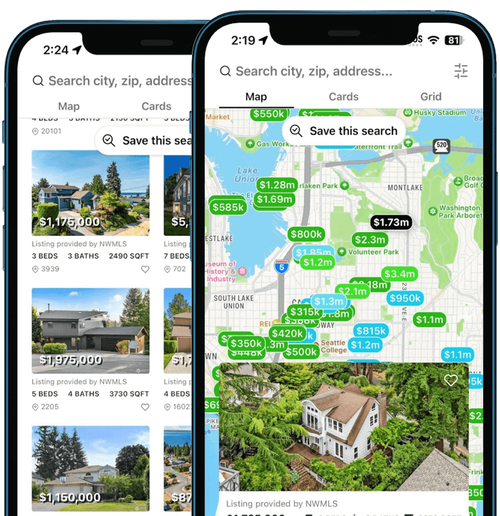
Download Our App
Smart real estate, right in your pocket.
Search listings, track market trends, and connect with our team—all in one place. Experience data-driven insights and tools designed to make buying, selling, and investing simple.