
KEY TAKEAWAYS
- Washington's real estate excise tax is graduated: 1.10%, 1.28%, 2.75%, then 3.00%, by price band.
- On an $890,000 Seattle sale, state and local excise tax comes to $14,902.
- The seller normally pays excise tax, owner's title insurance, part of escrow, and prorated taxes.
- Since August 2024, buyer-broker compensation is no longer published on the MLS and is negotiated in the contract.
What is the Washington real estate excise tax, and how is it calculated?
Washington charges a real estate excise tax (REET) on the sale of real property, and the seller is normally the party who pays it. On most Washington sales it is the second-largest line on the settlement statement, behind commission. The state portion is graduated, meaning each slice of the price is taxed at its own rate rather than the whole price at one rate. Per the Washington Department of Revenue, the rates effective 1 January 2023 are:| PORTION OF SALE PRICE | STATE RATE |
|---|---|
| $525,000 or less | 1.10% |
| $525,000.01 – $1,525,000 | 1.28% |
| $1,525,000.01 – $3,025,000 | 2.75% |
| $3,025,000.01 and above | 3.00% |
What does that look like on a real Seattle sale?
Take Seattle's citywide median of roughly $890,000.| LINE | CALCULATION | AMOUNT |
|---|---|---|
| State REET, first $525,000 | $525,000 × 1.10% | $5,775 |
| State REET, $525,000.01–$890,000 | $365,000 × 1.28% | $4,672 |
| Local REET (Seattle, 0.50%) | $890,000 × 0.50% | $4,450 |
| State technology fee | flat | $5 |
| Total excise tax | $14,902 |
How the rate climbs as you move up the brackets
Because the tax is graduated, the effective rate rises with price. The same arithmetic at four price points:| SALE PRICE | TOTAL EXCISE TAX | EFFECTIVE RATE |
|---|---|---|
| $525,000 | $8,400 | 1.60% |
| $700,000 | $11,515 | 1.65% |
| $890,000 | $14,902 | 1.67% |
| $1,300,000 | $22,200 | 1.71% |
| $2,000,000 | $41,642 | 2.08% |
When is excise tax actually paid?
At closing. The tax is due at the time of sale, and in practice your escrow agent collects it from your proceeds and remits it along with a real estate excise tax affidavit. You will see it as a line on your settlement statement rather than as a bill that arrives later. Because it comes out of proceeds rather than out of pocket, sellers routinely discover it only when they read the settlement statement. Calculating it before you list is the difference between a known cost and an unwelcome subtraction.What are the other seller closing costs in Washington?
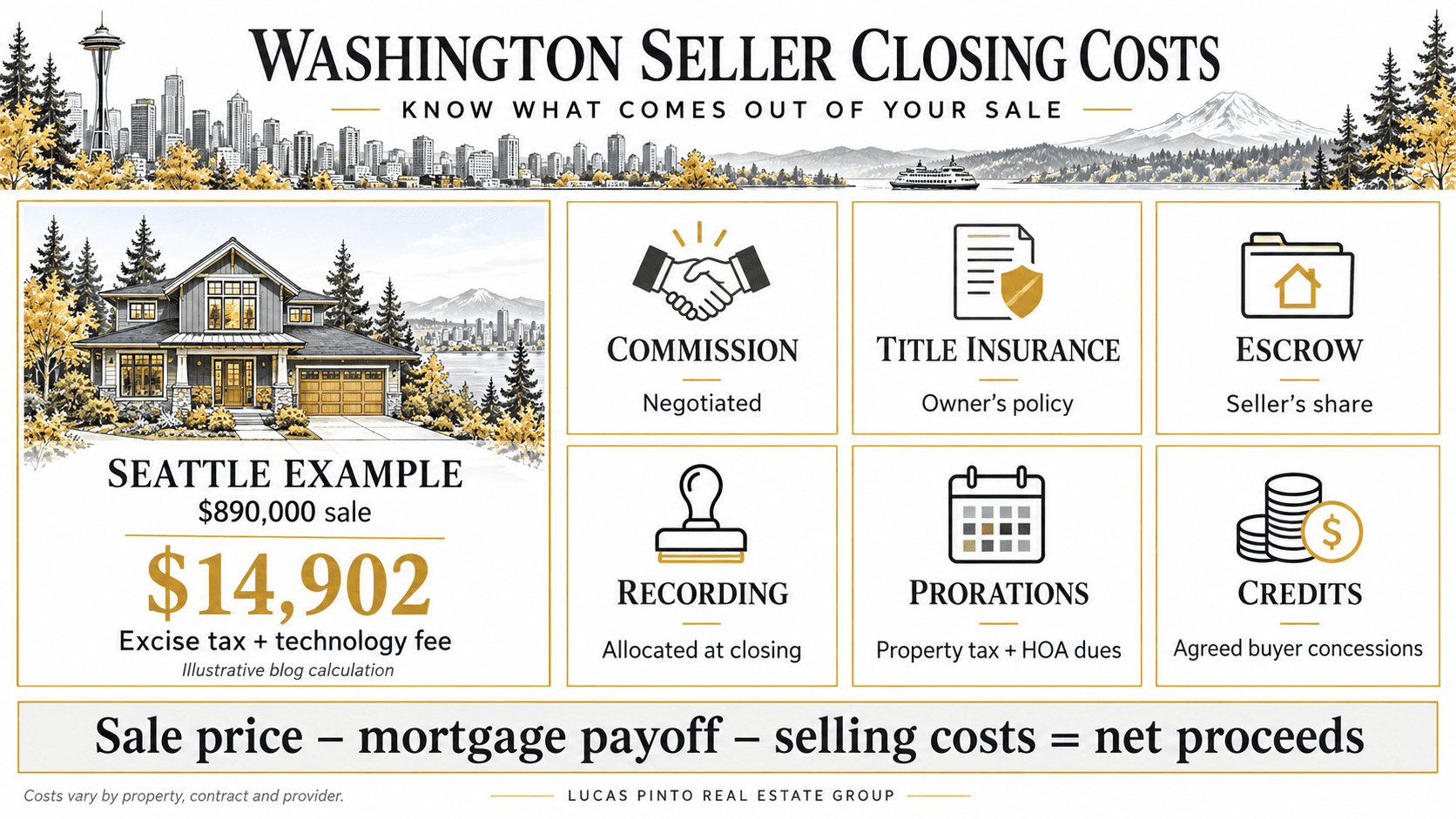 Excise tax is one line. Here's the rest of the statement.
Brokerage commission
Still the largest single cost, and the rules changed recently. Since 17 August 2024, under the National Association of Realtors settlement, offers of buyer-broker compensation can no longer be published on the MLS. Compensation is negotiated directly and written into the purchase and sale agreement. For sellers this means commission is genuinely negotiable, and what you pay your own broker is a separate question from what, if anything, you contribute toward the buyer's. At an $890,000 sale, each half-percent is $4,450. Ask what you're paying for and what it buys.Owner's title insurance
In the Puget Sound region the seller customarily pays for the owner's policy, which protects the buyer against defects in title. In King County this commonly runs $1,000 to $2,500, scaling with sale price.Escrow / settlement fee
The escrow company's fee for handling the closing. It is typically split between buyer and seller, with the seller's share commonly $600 to $1,500 depending on price and company.Recording fees
The county charges to record the deed and related documents roughly $300 or more per document in King County.Prorated property taxes and HOA dues
You pay property taxes for the portion of the year you owned the home, settled at closing. If your home is in an HOA, dues are prorated the same way, and the association may charge a resale certificate or transfer fee on top.Anything you agreed to in negotiation
Repair credits, a buyer closing-cost contribution, a home warranty. These are not standard costs they are the outcome of your negotiation, and in a market where homes sell near rather than above asking, they show up more often. The honest framing: the fixed costs on this list are knowable to the dollar before you list. Excise tax, title, escrow and recording can all be calculated in advance. What moves your net is commission and what you concede in negotiation. Those are the two worth real attention.What does a seller actually net?
Work it top-down, not bottom-up. Start with your sale price. Subtract the mortgage payoff, then excise tax, then commission, then title, escrow, recording and prorations, then any credits you agreed to. What remains is your proceeds. At $890,000 with a 5% total commission and no unusual credits, excise tax and commission alone account for roughly $59,400, or about 6.7% of the sale price, before title, escrow, recording and prorations. That's the honest starting point for the "6% to 8%" rule of thumb but the rule of thumb is the output, not the input. Calculate your own.Frequently Asked Questions
Who pays closing costs in Washington State?
Both parties pay, but different items. The seller normally pays real estate excise tax, brokerage commission, owner's title insurance, and prorated property taxes and HOA dues. The buyer normally pays lender fees, their own title policy and appraisal. Escrow and recording fees are commonly split or allocated by negotiation.How much is excise tax when selling a house in Washington?
It depends on price, because the state rate is graduated: 1.10% on the first $525,000, 1.28% to $1,525,000, 2.75% to $3,025,000, and 3.00% above that, plus a local rate 0.50% throughout King County. On an $890,000 Seattle sale the combined total is $14,902, or 1.67%.What percentage are closing costs for a seller in Washington State?
Commonly quoted as 6% to 8% of sale price, but that range is dominated by commission, which is negotiable. Excise tax alone runs roughly 1.67% at $890,000 and 1.71% at $1.3 million. The fixed costs are calculable exactly, so a real estimate beats a percentage.Do sellers pay the buyer's agent commission in Washington?
Not automatically, not since 17 August 2024. Under the NAR settlement, offers of buyer-broker compensation were removed from the MLS, and any seller contribution toward the buyer's agent is now negotiated as a term of the purchase and sale agreement.Can you deduct closing costs when selling a house?
Selling costs such as commission and excise tax generally reduce the amount realized on the sale, which reduces your taxable gain rather than serving as a direct deduction. How that interacts with the federal primary-residence exclusion depends on your situation this is general information, not tax advice, so confirm the treatment with a CPA. Want a real net-proceeds figure for your address? The fixed costs can be calculated exactly before you list.Sources
Sourcing note. Excise tax rates, brackets and local rates are primary, retrieved directly from the Washington Department of Revenue. Title, escrow and recording amounts are customary ranges reported in 2026 market guidance, vary by provider and are not fixed by statute confirm yours with your escrow company.- Washington State Department of Revenue, Real estate excise tax, retrieved directly 2026-08-22, https://dor.wa.gov/taxes-rates/other-taxes/real-estate-excise-tax
- Washington State Department of Revenue, Local Real Estate Excise Tax Rates, effective March 1, 2026, retrieved directly 2026-08-22, https://dor.wa.gov/sites/default/files/2026-01/84-0013-Mar26_REET.pdf
- National Association of Realtors, NAR Settlement FAQs, retrieved 2026-08-22, https://www.nar.realtor/the-facts/nar-settlement-faqs
- Title, escrow and recording ranges: customary King County figures as reported in 2026 seller cost guidance (secondary)

Check out this article next